A Zillennial’s Attempt at Understanding a Post-9/11 World
Every American has their story that starts off by answering the question:
“Where were you when…?”
Cracker Barrel.
The location in Holyoke, Massachusetts, to be exact. My dad took the whole family for my mother’s 29th birthday. I’d just turned two and my brother was a mere three-month-old, thus this recollection is not my own. It is what I’ve been told.
Apparently it started with banter from the waitress that some amateur pilot really screwed up and clipped the North Tower. Before long, the entire establishment sat silently listening to the gut wrenching play-by-play over the radio of a national travesty unfolding. Quite an insane way to be taking in world-altering news over a stack of buttermilk pancakes, if you ask me. My father’s law enforcement training dictated his next moves, getting his family to the safety of home as quickly as possible as uncertainty of what could possibly come next filled the imagination.
Some hell of a way to celebrate a 29th birthday. My mom has not particularly enjoyed her birthday ever since.
For those that do have a conscious memory of 9/11, my next statement may sound sick. I wish I had a memory of it.
On a surface level, for years I thought I had felt this way because maybe I’ve always been drawn by trying to understand tragic events. The moments, actions, policies, and happenstances all coming together to result in human-altering experience. That fascination is rather evident in my work if you ask my best attempt at an unbiased third-person perspective. But more recently, I think having a recollection of 9/11 would provide much more insight into the world that followed. Even more granularly, my own experiences in said world.
The wake for my second cousin, David Guindon, is something I think about a lot around 9/11. Having just turned five, this is a time where I first have real momentary, but really distinct memories. The first time smelling a funeral home is one that I doubt many forget. Like most smells, it is difficult to put into words, but yet, when you mention it everyone knows exactly what you are talking about. I remember being sat in the lobby area with my other cousins, drawing with a pen on the back of one of those paper placemats you’d get at some restaurants. I looked into the eyes of people I’d never met before, standing over me saying things like, “look how big you’ve gotten,” with a positive inflection, but were clearly crying minutes earlier. I don’t remember much beyond that, but that was my first exposure to death.
That damn smell.
From old family members that lived a full life, to a close friend that took their own, to a cousin killed in the line of duty (most tragically, that was the daughter of David 12 years later), to an uncle that overdosed, and a few more to terminal cancer, I’ve been around death and its various timely and untimely flavors more than most at the age of 27. I have friends that still have never been to a funeral, which I find shocking. Regardless, you never forget your first.
The significance of David Guindon’s death was his six-month tour to Iraq in 2004. Attached to the 2632nd Air Expeditionary Force Truck Company, he was an Air Force reservist put into an Army role to serve as a security detail for convoys. He carried out his duty in over 100 missions, encountering firefights, roadside IEDs (Improvised Explosive Device), and the inhuman tactics that insurgents used to attempt to get convoys to slow down in order to ambush (I’d go into more detail, but it is quite sickening). This combat-ladened tour meant TSgt. David Guindon came home to a hero’s welcome on August 17th, 2004.
He took his life 24 hours later.
A Brown University study estimates over 30,000 post-9/11 veterans have taken their own lives, a figure that is four times higher than the official KIA (Killed In Action) total from the Global War on Terrorism. Roughly 4,500 American lives were lost in Iraq specifically. So many of them were young 20-somethings that enlisted in the 9/11 aftermath. Who is to say I wouldn’t have done the same. Others, like David, were reservists with families that heeded their call to duty.
Sitting here today, knowing all too well that we went into Iraq in 2003 based on false premises of the Saddam regime supporting al-Qaeda and the possession of WMDs (Weapons of Mass Destruction), it is a case of hindsight being 20/20 to me. It seems so obvious that it had nothing to do with 9/11. Afghanistan makes total sense at the moment. The Taliban protected al-Qaeda. However, when you factor in the raw post-9/11 emotions, there’s a general anger held by the collective American people that wanted revenge. A revenge at some entity half a globe away in the Middle East that became blurred by both blind anger and geopolitical ignorance. Entities like al-Qaeda and Iraq were seemingly synonymous to most people, draped under one giant Middle-Eastern umbrella. When you remove the emotional component and look more into the matter, it is clear how different both the Iraq and Afghanistan situations were. The end result was Iraq devolving into an insurgency power struggle.
It is a battle of logic, emotion, and political games to try to justify how the dominos from 9/11 led to all of this additional suffering for American families in a cause that isn’t even directly linked. The ultimate ugly truth is needless loss of life is a harsh reality of this world. That still does mean we don’t try to understand why regardless. World history altered with 25 years of consequences paid for in human lives. Never mind the innocent lives that were caught in the crossfire with not only our involvement, but those holding ruthless ideologies we went after in the first place.
It’s all a mess. It may be easier to just leave the rabbit hole undug.
~
My partner, also two at the time, was not at a Cracker Barrel in Massachusetts during 9/11. She was in Manhattan.
Her family lived in an apartment off on 14th Street, the line of demarcation for Lower Manhattan from Midtown, some two miles as the crow flies from Ground Zero. Other family members of hers were working in the Financial District with the worst front-row seat imaginable.
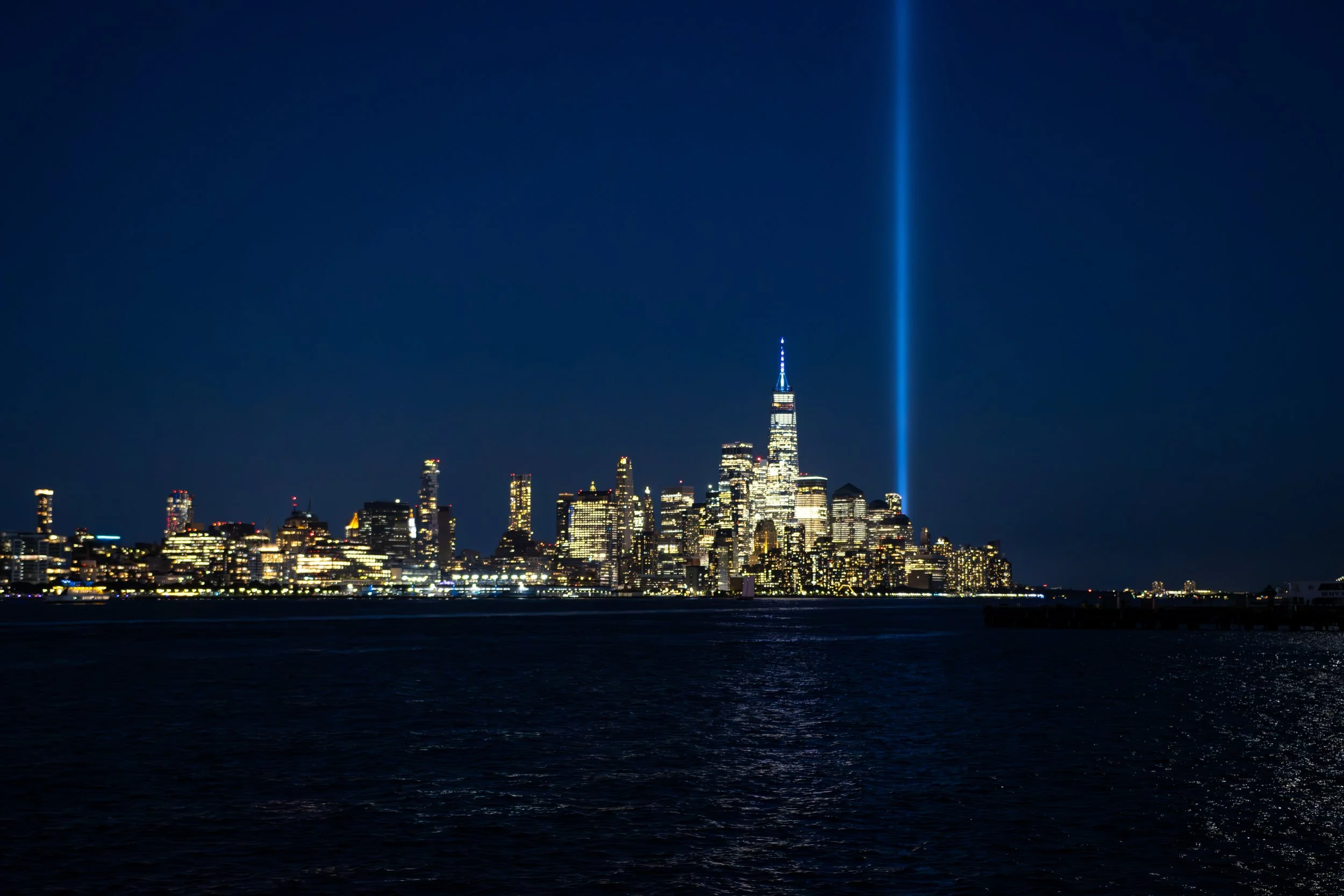
Now being a pseudo New Yorker across the Hudson in Hoboken, I gravitated to her family’s various perspectives of the day. I try so hard to put myself in those shoes to grasp the monumental moment of standing in the city, one second looking at a presumed crazy accident at the North Tower to realizing we are under attack when the second plane hits the South Tower. What a sickening moment that is probably unlike anything else. It is that type of emotion I’m still trying to understand. It may be a helpful key to the justification that my brain desires of what further transpired in the weeks, months, and years to come.
So many focus on the day’s events itself, that there were aspects I never really considered until hearing these primary perspectives. Most haunting was from my partner’s uncle, who worked blocks from the Twin Towers and had to walk over the Brooklyn Bridge to a friend’s house to call home in New Jersey to let them know he survived. He spoke of the cars in the parking lot of his local NJ Transit station, sitting for weeks collecting dust before finally being towed away. Minus the absence of the towers themselves, these personal artifacts were daily reminders of individuals lost.
The most connection I’ve felt to 9/11 is through the lens of having a parent that is a first responder. 343 firefighters, 71 law enforcement officers, and 8 EMTs/paramedics were lost. My father worked as a police officer for the city of Holyoke, Massachusetts, where every day he left for work, there was a chance his life would be taken maliciously. Two years prior to 9/11, my dad’s coworker and more importantly friend, John DiNapoli, was shot and killed in his cruiser. It was a dark reality of the profession that most resulted in people being safe. That moment was devastating for the community and had a years-long rippling effect. Now multiply that many times over in the case of 9/11. All those kids that lost their first responder parent on that Tuesday, like Pete Davidson, for a famous example. Sure, it was the duty of the parents to fulfill the role of their profession, putting their wellbeing on the line in order to save however many thousands. It still doesn’t make the loss any easier.
The other side of the coin when it comes to not having a memory of 9/11 is the resulting unifying patriotism in immediate wake. The idea of American flags everywhere and the dissolvement of political factions; just Americans. A pride shared that has not been experienced since. Most people today out in the world away from the Internet interact fairly harmoniously, with more things in common than not. However, there is still division visible, with signs of unwavering loyalty to the party (or even person) in disguise as patriotism. The Internet isn’t even worth discussing because it is designed to be decisive. At a fundamental level, we all want the same thing. Things like happiness, prosperity, and so forth. There’s just different avenues to get there that we all conversate and argue over.
It would be nice to have some semblance of a united nation once again. I don’t want it to come in the wake of horrific tragedy, but that may be the only thing that brings people together. Polarization and this growing need to win arguments over understanding, however, may just be too much to overcome.
If you ever have the opportunity to come to New York City, my first piece of advice is avoid Time Square. It is highly overrated. Secondly, get to the 9/11 Memorial pools. Spend some serious reflecting time there. It is a profound and often sobering experience.
To the 2,977 victims.
To the thousands of responders with life-altering health complications.
Lest we forget.