If you told me back in high school that by my late 20’s I’d only be driving once a week or so, I wouldn’t have believed you.
When I was in high school, there was nothing more I wanted than my driver’s license. Being a late-August birthday meant I was one of the last in my class to get that coveted means of next-level freedom. This was during a time when shows like Top Gear were at its peak and I was getting more serious about my interest in storm chasing. I was starving to be behind the wheel.
Fast forward over a decade later and I still love driving, but like anything else that you have to do day-in and day-out, the fun of it eventually wears away. It became the commuting necessity that it is in the majority of corners of America. It also comes with the aches and pains of the associated infrastructure and markets. Traffic, deteriorating roads, and American consumerism inflating the function of cars as status symbols puts both mental and financial strain on the commuter, many of which don’t share the same passion of vehicles that I do.
I felt this in my own life with my first engineering research fellowship that had me commuting through Hartford, Connecticut each morning and afternoon. The traffic of I-91 at peak hours drove me up a wall enough to a point where I’d wake up earlier so I could both avoid the peak morning traffic and leave work to miss the afternoon traffic. I was altering my entire day’s schedule around what minimized my commuting headaches. That’s a pretty wild concept when you think about it.
Even more troubling for many is that financial pressure. For example, I bought my Subaru Crosstrek in March of 2021 as an early graduation present for myself. I had saved up for a down payment and locked in a good interest rate on a car loan. With an engineering job lined up and knowing I would be living from home for the next while, I felt comfortable making that purchase. Fundamentally, I was buying a really expensive tool to get me from point A to B that after insurance and car payment was taking over $500 out of my pocket every month. Thankfully, this was well within my budget and was never an issue, but I can say that out of some level of privilege. My circumstances allowed me to live at home for a bit and not have to worry about rent. There are so many my age that could not enjoy said circumstances on top of not having an engineering gig that pays out well-above the typical new grad salary.
…and those costs were only for a certified pre-owned Subaru; a very standard and moderate car.
Despite all that, the idea of walkable cities wasn’t one that I felt that impassioned about. I think I was resigned to the idea that American infrastructure just couldn’t support it. At the time, my ignorance won the battle.
—
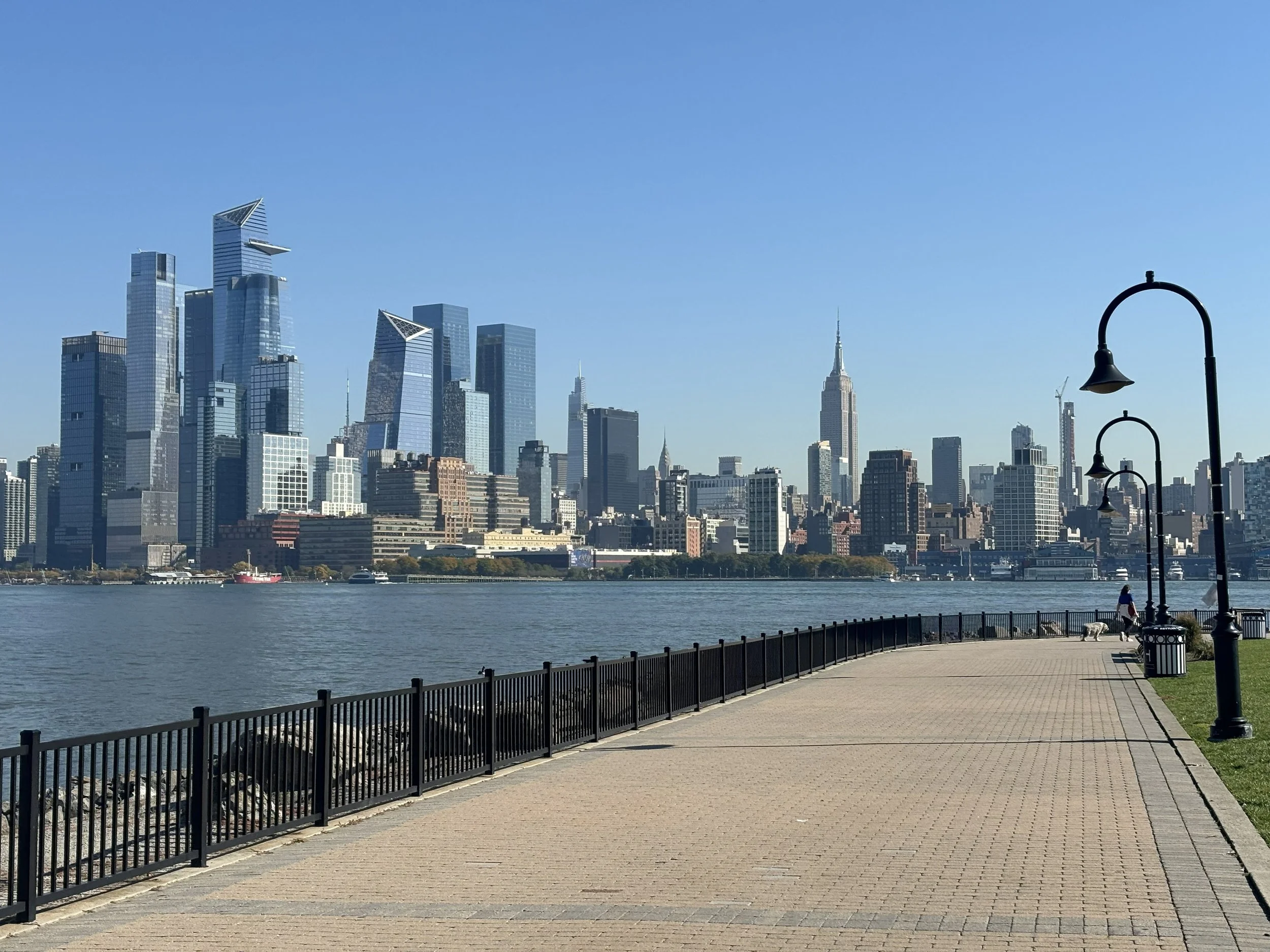
Hoboken’s waterfront view of Midtown Manhattan.
For many young adults, the first experience of a pseudo walkable community was college. I was no different going to Quinnipiac University in Hamden, Connecticut. Unlike our rival Yale down Whitney Avenue in New Haven, Quinnipiac wasn’t built into the surrounding city’s infrastructure. It was rather isolated and insulated from the greater community. It was nice to walk to class, the dining hall, or recreational places, but I had yet to see the benefit in a real-world setting. I must admit that every time I was in New Haven around the Yale campus during that time, my focus was not on the walkability, but rather what the lines to the bars and clubs looked like.
But after years of staying in a rather car-dependent western Massachusetts post-college, my long-term girlfriend and I finally made the decision to move in together. The only question was where. Given she was just getting her career started after her masters program concluded, I had more flexibility to move down to her in Northern New Jersey. Not long before this decision we had visited two cohorts of our college friends that lived in the city of Hoboken. Beyond knowing it was the birthplace of Frank Sinatra and first game of baseball, I knew little more about it. Quickly though, I fell in love with it. The best way I can put it is it has the best elements of New York City without the same level of craziness. The restaurants, shops, bars, and amenities were all tightly integrated with residencies. The main streets had street-level businesses with floors of apartments above, while even more interior neighborhoods of brownstones still had corner cafes, shops, and pizza spots. Parks were littered throughout and you never were too far from greenery, believe it or not. To top it all off was the incredible waterfront that has the BEST view of Manhattan possible (that’s right, the best view of New York is in New Jersey).
Hoboken is THE most walkable city in America (Walkability Score of 99/100) and in many ways is the poster child for the American urbanism movement. Going into my third year living here, I can confidently say why so many my age long for communities to be constructed like this. As mentioned earlier, the utilization of blended commercial and residential spaces within buildings themselves and even their zoning allows for really easy access to everything I could need on a day-to-day basis. Within a 5 minute walk of my apartment are 3 grocery stores, 3 gyms, 2 convenience stores, a couple dozen restaurants, 2 barbershops, 2 liquor stores, 4 standard parks, 2 dog parks, more tailors than I could count, a dentist, several physical therapy places, a 24-hour vet, an urgent care, multiple small business shops, a waterfront walking path, and of course a handful of bars. I can keep going on and on with what is within a reasonable walking distance from my apartment.
Let’s say I forgot something at the grocery store for a recipe I was making. Back in western Massachusetts, I’d have to get into my car, drive down the hill from where I lived to the congested strip mall area to my local large grocery store, park, go in, get what I needed, drive back up the hill through a congested Route 5, likely totalling to a 20-30 minute roundtrip. Here in Hoboken, I can set a timer the moment I walk out the door of my apartment and be back with what I need before that timer clicks over the 5-minute mark.
Diving more into the infrastructure itself, Hoboken does prioritize the pedestrian more than any other community I’ve been to. Crosswalk bumpouts preventing parking on the street corners allow for high-visibility of pedestrians. The city-wide speed limit is 20 miles per hour, which you rarely hit given how frequent intersections are with optimized block grid layout. 20 mph was a very intentional choice on behalf of the city. It used to be 25 mph, but was reduced in 2022 given a National Cooperative Highway Research Program (NCHRP) study found that pedestrians stuck by a vehicle at 20 mph only have a 5% chance of dying. That figure skyrockets to 45% at 30 mph. The traffic signals themselves prioritize pedestrian crossing patterns over that of vehicles. All of these actions were a part of Hoboken’s Vision Zero Strategy to promote pedestrian safety. The actions have worked, with the city of over 60,000 residents not seeing a single pedestrian fatality for over 7 years.
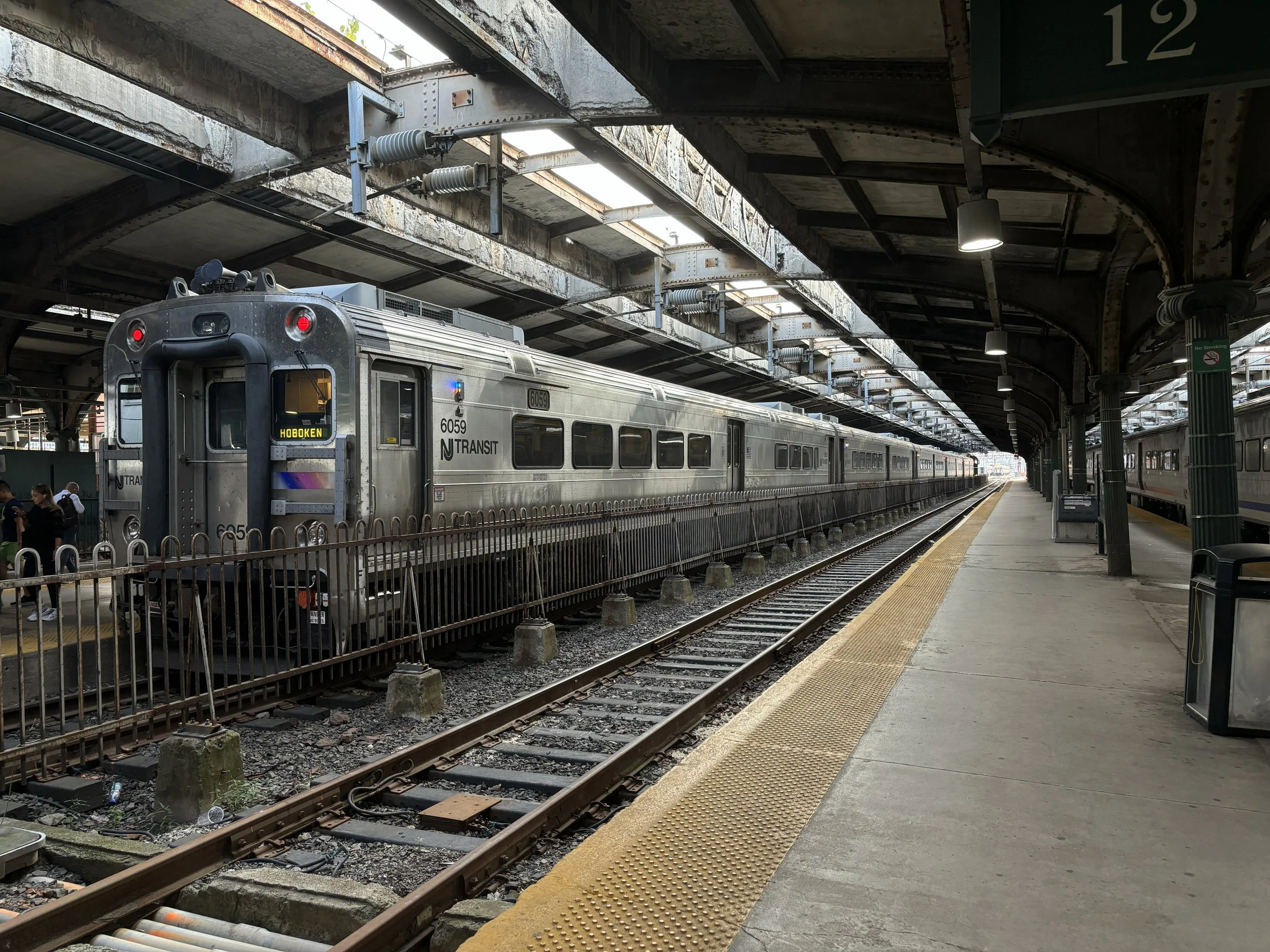
Hoboken Terminal
All of this does not mean you cannot have a car here. Plenty do, in fact. Residential street parking lines every single road that requires a parking permit that only costs a reasonable $75 a year. Multiple city-owned parking garages are also dotted around the city with dedicated parking spots that you can reserve for a monthly fee. Plus, for those just coming in for a visit, the main drag of Washington Street has plenty of parking-metered angled parking as well as several more private parking garages. It is still a city after all, so it will cost to park regardless.
The great news is that you really don’t even need to drive in to enjoy the beautiful ‘sixth borough’ of NYC. Hoboken is a fantastic model for public transportation in the United States. Of course, it has been baked into its nature being a part of greater NYC, but there’ve been newer projects deep into the car-dependent era that have improved the city’s public transit. The hub of the city’s network is Hoboken Terminal, an intermodal station that connects multiple individual means of public transport. 8 different NJ Transit commuter rail lines terminate here with 18 different tracks for added variations of the more popular lines. Linking into the city itself is the PATH subway, a network different from that of New York’s MTA that connects to various stations through the West Village up to Midtown, plus another line to the World Trade Center. Other PATH lines also connect neighboring Jersey City and Newark to the network. The 3rd rail option is NJ Transit’s Hudson-Bergen Light Rail, which serves as the terminus for 2 of the 3 lines of this system that further connects Hoboken to areas like Weehawken, Union City, North Bergen, and Bayonne. Not a fan of rail? Well Hoboken Terminal has multiple slips for NY Waterway ferries connecting to Midtown, Battery Park, and Wall Street. Finally, 10 NJ Transit bus lines also connect through the terminal, including the popular 126 line that goes through all of Hoboken then straight into the Lincoln Tunnel to the Port Authority Bus Terminal in Midtown. Simply put, Hoboken’s connectivity to both New York City and northern New Jersey can effectively get you anywhere you need to be in the greater NYC metro, including the major airports with the right connections.
It is important to note that Hoboken was an industry town for much of the early 20th century, serving as a massive port given the connection to the railhead at Hoboken Terminal. The majority of American troops that served in World War I departed and returned via the slips of Hoboken, making the phrase, “Heaven, Hell, or Hoboken,” one that is embodied in the city’s history. After that era, companies like Maxwell House, Lipton Tea, and Bethlehem Steel all operated out of Hoboken for a prolonged period, but it didn’t last. When those industries moved out of town, the city had to innovate and change its identity to survive, eventually evolving into the commuter city that it is today.
Beyond the great accessibility of basic needs and commuting options, living in Hoboken for the past couple of years has also completely changed my social life for the better. Just like college, living a walkable distance from friends or activities makes them both more accessible and increases the likelihood of making it happen. This is especially true for people my age where meeting for dinners and drinks is rather frequent and you never have to worry about getting behind the wheel inebriated. With my closest college friends a few blocks down, any time there’s a good game to watch, on a whim I can shoot a text saying come swing through and they’ll be at my door in 5 minutes. With my girlfriend, even after over two years of living here, we are still finding new places to eat, grab a coffee on our weekend walks, or cool little specialty hole-in-the-wall shops. We found a store that sells pickles for crying out loud. That’s right, just pickles!
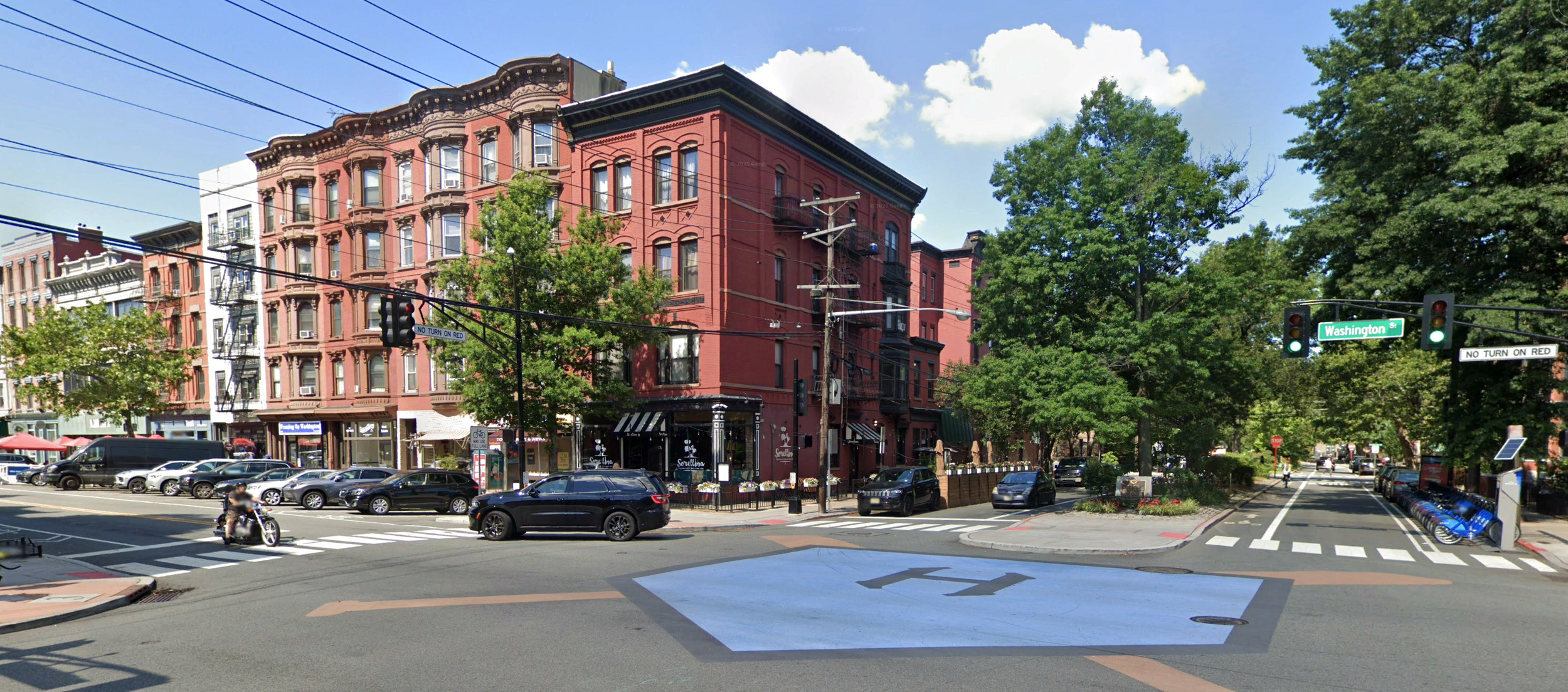
The corner of Washington and 11th Streets in Hoboken.
I don’t think the automobile will ever be replaced as the primary mode of transportation for the majority of America. However, living in Hoboken has opened my eyes to the fact that moving away from car-dependent cities is still doable for the current car-dependent cities. Yes, Hoboken had early industrial ties to things like the terminal, but things like the Light Rail system were only introduced at the turn of the 21st century. Looking back 25 years ago, satellite imagery of uptown Hoboken shows blocks of parking lots that are now occupied by multi-use buildings. Other big-named cities are trending in that direction, like Seattle, Denver, and Atlanta. More importantly though in my estimation, are that some of the smaller cities are also adopting an urbanist approach. Examples include Dublin, OH (greater Columbus), Burlington, VT, and Lancaster, PA.
While I may have been clear up front that I do love driving and cars, I was also an obsessive kid when it came to any mode of transportation, especially trains. It is another backstory piece that definitely contributed to my degree in Mechanical Engineering, but I know that little Ethan would be so happy to hear that trains became a part of his life again down in the mile-square city of Hoboken, New Jersey.
—
Hopefully this was an enjoyable and educational read. I’m trying to write more about other topics outside of weather as I look to expand into new topics to cover. I’ve grown to love writing over the past few years with the scripts for June First, so it’ll be something that I’ll continue to work on as I figure out how I want to evolve the journalistic side of my STEM career. Maybe the whole urbanism/Hoboken thing will be a great breakout video on my new personal YouTube channel that is outside of June First. Please consider subscribing early: https://www.youtube.com/@ethan_moriarty