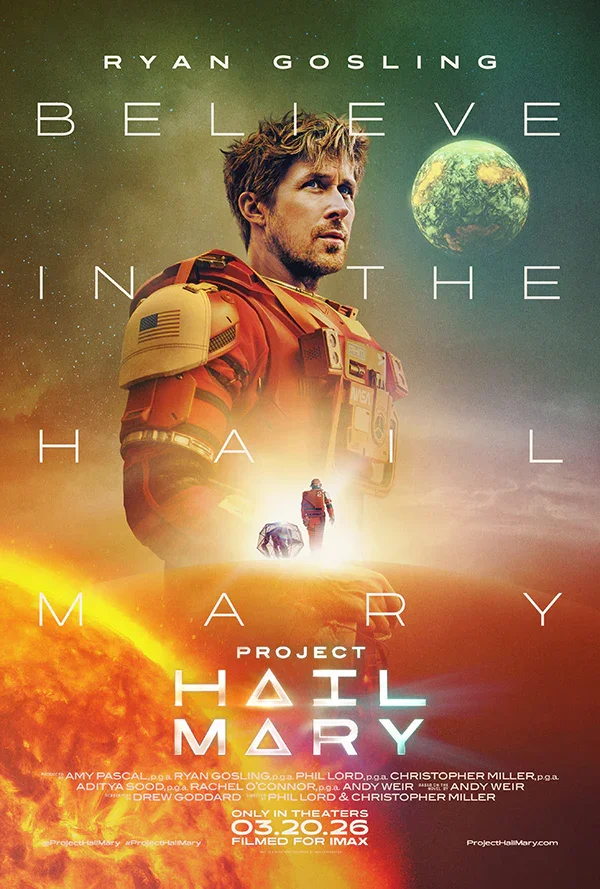
Project Hail Mary Theatrical Release Poster
Amidst a chaotic world in early 2026, one piece of media has everyone talking. Project Hail Mary has captivated movie audiences, including myself.
I had the pleasure of taking my dad to see it this past weekend and it was a thoroughly enjoyable experience. Having both watched and read Andy Weir’s, The Martian, plus the public praise, I went in with fairly high expectations. It not only met my expectations, but far exceeded them. For the past 48 hours, I’ve been digesting what I watched in that 2 hours and 30 minutes and the lessons that I gathered that go well beyond the film itself.
Full disclosure up front; I have not yet read Project Hail Mary. I’m ashamed to admit it, but I’m usually more drawn to non-fiction (which I currently have a thick backlog of that I’m churning through) and wasn’t even aware of another Weir book until I saw the trailer for this movie a couple months ago. Regardless, in the wake of this movie it is now jumping towards the front of the queue. This also means that some of the science things that I would’ve liked expanded upon in the movie are likely covered in greater depth in the book, similar to the relations of both mediums of The Martian. Not to be the, ‘the book is better,’ guy, but the book The Martian was fantastic at getting into the details that a STEM-orientated person cares about. I completely understand where filmmakers need to come from in order to give the movie a reasonable runtime. All of this is to say I really look forward to getting into the book Project Hail Mary in order to scratch the few (very few) itches I had coming out from the movie.
Beyond some broad plot points evident in the trailers, I will not be going into spoilers here. Consider this a warning if you are one of those people that completely avoid trailers ahead of seeing a film (no judgement, I completely get it considering how much some trailers give away). What I felt compelled to write about were how this piece of media left me feeling incredibly optimistic in a time where collective optimism seems to be at an all-time low in my lifetime.
The past two years or so have been dominated by the growing reality of Artificial Intelligence. It is the favorite buzzphrase of every Fortune 500 company and the social feeds are filled with proverbial ‘slop.’ While CGI (Computer-Generated Imagery) has been a part of the movie industry for decades now and is tackled by extremely talented artists, it was extremely refreshing to learn that so much of Project Hail Mary was shot with practical effects. For those not familiar with the behind the scenes of movies, practical effects are physical props, illusions, and techniques used to create added elements in film. The most classic example of practical effects is the original Star Wars trilogy, where so many of the vehicles, sets, and visual effects were completely done with practical effects. If you’re at all interested in the art of practical effects, I HIGHLY recommend the documentary series Light & Magic on Disney+. It goes deep into the history and advancements of Industrial Light & Magic, the effects company born out of the original Star Wars movies.
Practical effects are incredible works of both artistry and science. Project Hail Mary is a beautiful example of how practical effects still have a place in the media today. The ship was an entirely practical set, one of the main characters was puppeteered, and many of the space elements were completely practical. If you’d like to learn more about the practical effects used in the movie, check out this video done by Adam Savage’s TESTED. Not only is it so refreshing to see the choice made directorially to opt for the more expensive, more time consuming art of crafting these practical effects, but the fact it likely yielded a WAY better product. As incredibly talented and dedicated to his work Ryan Gosling is, the performance he gives is probably more believable because of the fact that he’s actually interacting with a practical environment around him. It could’ve been so easy for a studio or director to say, “hey, we can save money here by shooting all of this on a green screen and build the whole environment in post production.” They did the opposite, went the harder route, and the end result felt AUTHENTIC.
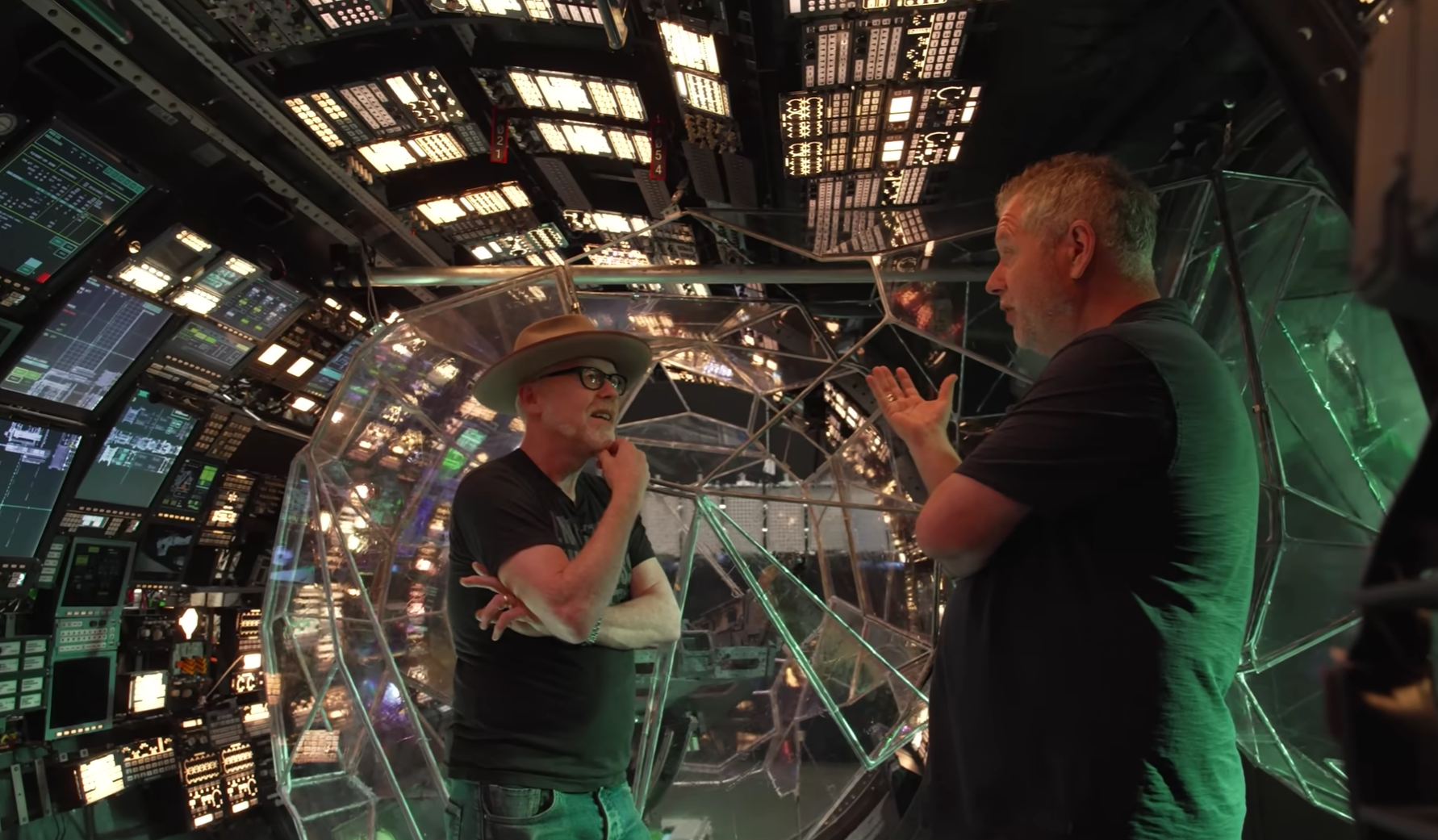
Adam Savage listening to Project Hail Mary Production Designer Charlie Wood inside the cockpit practical set.
Authenticity seems to be an attribute that is disappearing more and more the further along the timeline we crawl. Project Hail Mary stands out mightily in an increasingly ‘generated’ world.
Released in 2021, Andy Weir released his book Project Hail Mary in a time where things were incredibly unsteady in the greater world. 5 years later, that same unsteadiness has prevailed. The theme that I and many others would associate with this stretch of time is division. Project Hail Mary though is the opposite. Its theme is unification.
Instead of being pitted against one another, all the parties of Earth come together to face the common problem; the dimming of the sun from what is essentially a space infection. Not only did this collaboration and unification happen on Earth, but it happened interplanetarily. When was the last time you watched a movie involving an alien lifeform that didn't have any inkling of some form of malicious intent? ET, I guess? A movie that came out 44 years ago. Back when this book was likely in the later stages of writing, the world fell into a pandemic on a scale not seen in over 100 years. While the argument could be made that it was not as pressing an issue as decades away from complete extinction, the nation and even the world had an opportunity to come together to combat a universal problem. Instead, the opposite happened, particularly within our own nation of the United States. Unfortunately, it's hard to say if the level of collaboration between nations seen in Project Hail Mary would work if we were faced with the exact same problem. A comparison could be made to anthropogenic climate change, something that in theory could alter things on earth drastically in several decades. Despite the clear evidence of its existence, it is still a point of contention for different parties and interests. Say right now we had the clear existence of evidence of the sun being dimmed to a point of causing near-term extinction, would we set aside differences to attempt to rectify the situation?
Project Hail Mary at least goes for the optimistic option. The movie is built upon the hope of a last-ditch effort to save humanity. Despite the reality we currently live in that feels like we’re heading down a dark path, it's works like Project Hail Mary that restore optimism and hope for humanity. If each individual moved forward each day with that type of optimism for one another, the collective sum of little positive actions combine into net positive for all of humanity one step at a time.